
 Tree down on the roof?
 Address not listed?
Support systems · Lake City, FL
Tree Cabling & Bracing in Lake City, FL
A weak fork in a valuable tree does not always mean the tree has to go. A cable high in the crown and a brace rod through the union can limit movement and buy years, as long as the rest of the tree is sound.
Tree Cabling in Lake City, FL: What It Can and Can't Do
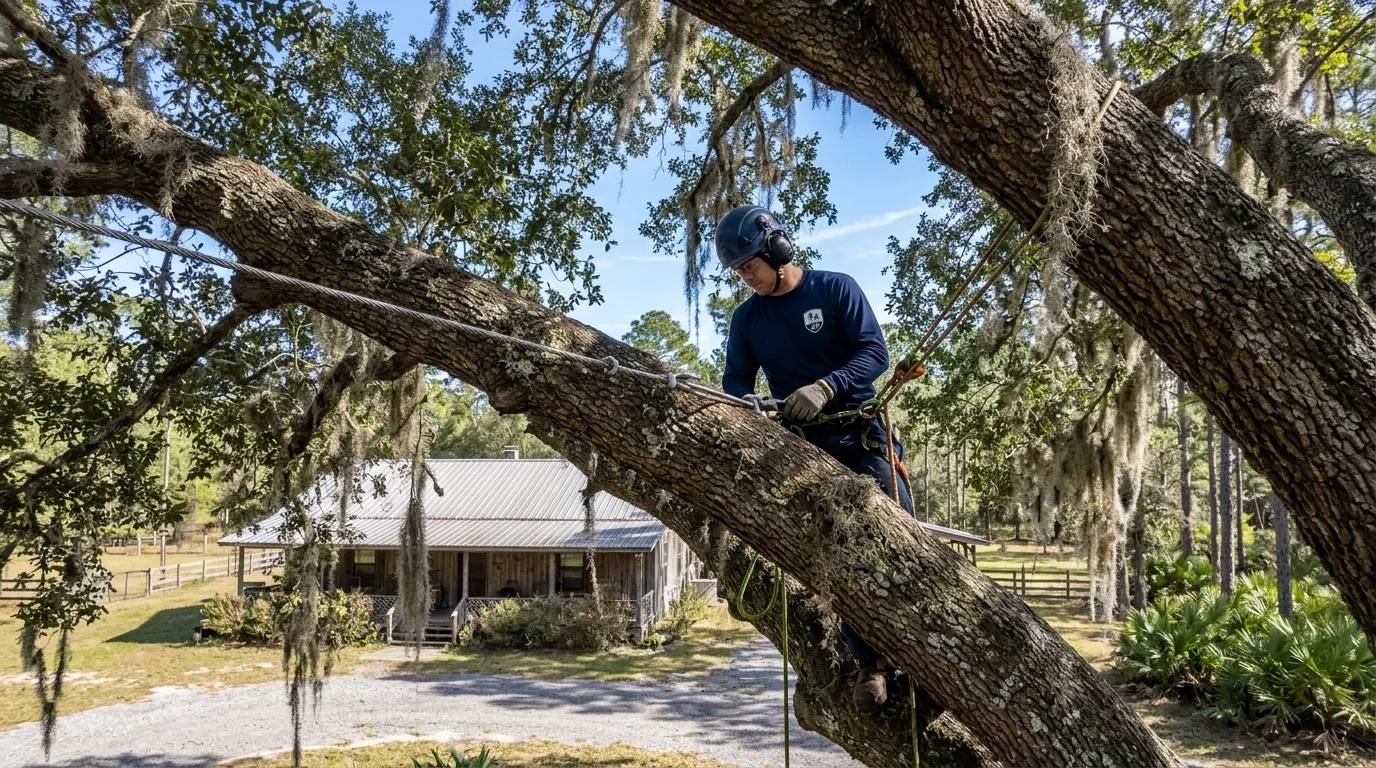
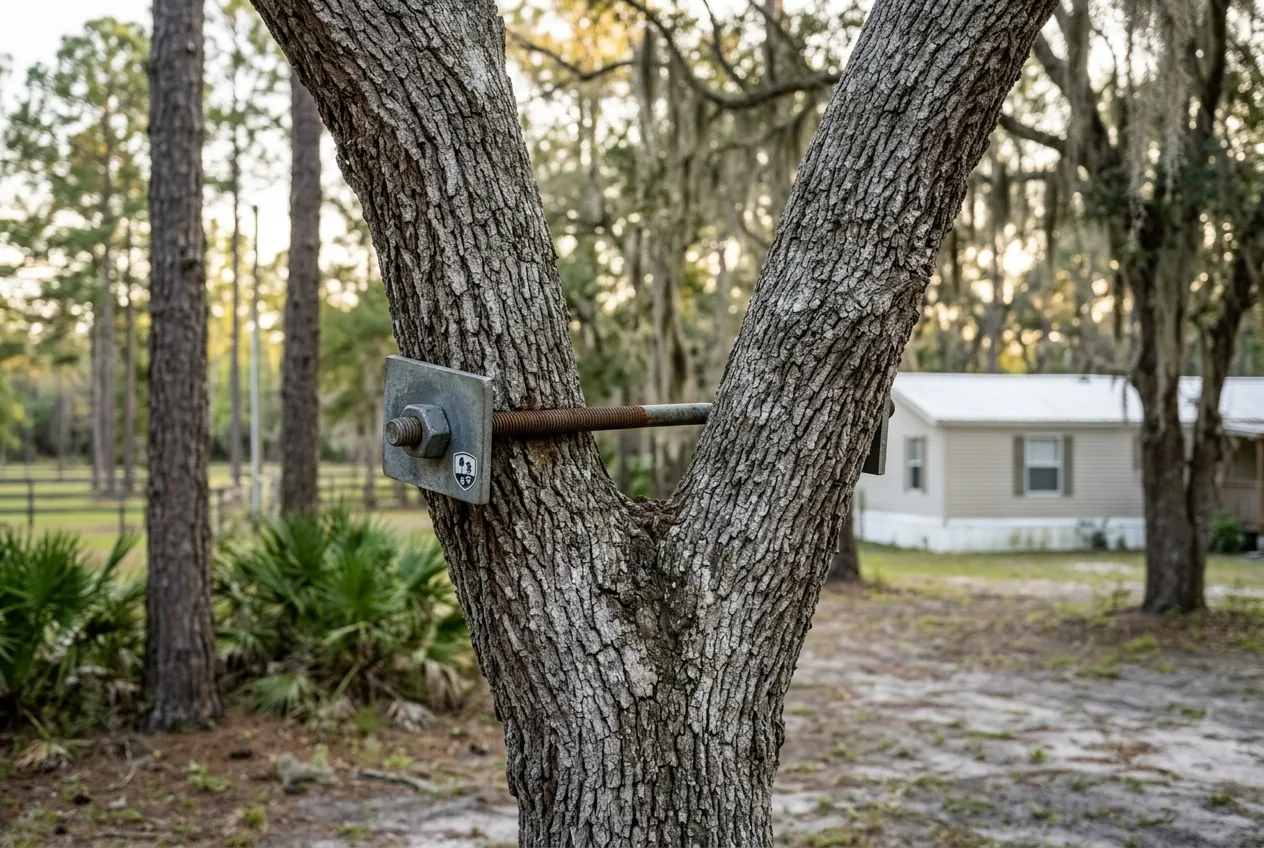
Cabling and bracing are support systems for trees with a structural weakness that is not yet a failure. A cable is installed high in the crown between two stems or limbs and limits how far they can spread apart in wind. A brace rod is a threaded steel rod through a weak union, lower down, to keep it from splitting or twisting. Used together, they reduce the strain on a fork that would otherwise crack.
What cabling cannot do is fix a tree that is already failing. If the trunk is hollow, the roots are rotten or the split has opened wide, hardware will not hold it together. Cabling also does not replace pruning. Most cabling jobs start with reducing weight on the limbs being supported, so the cable carries less load.
Tree Cabling and Bracing in Columbia County: Which Trees Qualify
- Co-dominant stems. Two trunks of about equal size growing from a tight V. Bark gets trapped in the union, and the joint is weaker than it looks.
- Live oaks with long, heavy limbs. Live oaks often grow limbs that reach far out horizontally. Shortening them reduces load, and a cable can add support where a limb is too important to cut.
- Trees with an old crack that has not moved. A small, stable crack in an otherwise sound union can sometimes be braced.
- Heritage trees on old homesteads. A big oak in front of a farmhouse that has stood for generations is worth extra effort when the structure allows it.
Laurel and water oaks are usually weaker candidates. They decay faster and their wood is less forgiving, so when a laurel oak has a bad fork, removal or heavy reduction is often the better call. Our oak tree removal page lays out how that decision gets made.
Tree Bracing in Lake City: How the Hardware Goes In
- We inspect the whole tree: root flare, trunk, the union in question and the limbs to be supported. If there is too much decay, we say so and stop there.
- Weight-reduction pruning comes first. Heavy ends of the limbs are shortened back to laterals so the hardware carries less load.
- Holes are drilled for through-bolts or lag hardware at points about two-thirds of the way up from the union to the ends of the limbs, following the ANSI A300 standard for supplemental support systems.
- Cable is installed with a little slack so the tree can still move. A tree that cannot sway builds weaker wood.
- For bracing, threaded rods go through the union below the weak point and are secured with washers and nuts.
- You get a written record of what was installed and where, for future inspections.
Tree Cabling or Removal in Lake City: Making the Call
Cabling is a good option when a tree is valuable, healthy and has one weak point we can support. It is a poor option when a tree has several problems at once, when decay is spreading, or when the tree is a species that tends to fail even with support. We weigh those factors with you, and the estimate will show both the cost to support the tree and the cost to remove it.
- Good candidates. A sound live oak with one long, heavy limb over the house. A young, healthy tree with two stems from a narrow fork that has not split yet.
- Borderline candidates. A mature tree with a weak fork and some minor decay in other parts. These may be worth cabling if the tree matters a lot to you.
- Poor candidates. A laurel oak with a hollow trunk. A tree with a split that has already opened wide. A tree leaning over the house with root damage.
Lightning is also part of the decision on big trees. A tall live oak in an open yard may be struck, and the FAMU extension guidance on cabling notes that lightning protection may be worth considering for cabled trees. If the tree is valuable enough to cable, it may be worth asking about that too.
Lake City Cabling and Bracing Cost
Cabling is priced per tree based on how many cables or rods are needed, how high they go and how much pruning comes with them.
| Job | Typical range | What moves the price |
|---|---|---|
| Single cable, medium tree | $350–$600 | Height and limb diameter |
| Multiple cables, large tree | $600–$1,200 | Number of cables and crown size |
| Brace rod through a union | $350–$800 | Trunk diameter and number of rods |
| Cable plus brace combination | $700–$1,200 | Complexity of the weak point |
| Weight-reduction pruning with cabling | $275–$1,100 | How much load must come off |
| Inspection of existing hardware | Often with other work | Height and number of installations |
Pruning that accompanies cabling is priced like other tree trimming. If the inspection shows the tree is beyond support, the estimate will compare that with the cost of tree removal so you can decide.
Tree Support for Young Trees in Lake City
Support is not only for old trees. Young trees planted after a removal or a storm sometimes need staking for their first season so the root ball stays put while roots grow into the surrounding soil. Stakes should be loose enough to let the trunk move a little, because movement builds trunk strength. Staking left on too long can girdle the bark and leave a tree that cannot stand on its own.
Structural pruning in the first few years does even more. Choosing one central leader, removing competing stems and spacing out the main limbs while the cuts are small keeps the tree from developing the weak forks that need cabling later. If you have recently planted shade trees, our tree trimming crew can do this on the same visit as other work. It is one of the least expensive things you can do for a tree's future.
Tree Cabling Before Storm Season in Columbia County
Hurricanes Idalia, Debby and Helene all brought wind and heavy rain to this area between 2023 and 2024, and split forks were among the most common failures in large yard trees. If a big tree near the house has a V-shaped fork, the off-season is the time to have it looked at. Cabling installed before a storm can limit how far a fork spreads in wind. After a fork has torn, support usually comes too late. The hurricane tree prep checklist for Lake City homeowners lists other things to check.
What to watch between inspections
You do not need to climb the tree to keep an eye on it. From the ground, look for a cable that sags noticeably, a fork that seems to be opening wider, fresh cracks near the hardware, or bark bulging around a bolt in an odd way. After a strong storm, check that nothing has snapped or pulled loose. If anything looks different from the last time, text a picture and we will say if it warrants a trip out.
Tree Support Systems Around Lake City
We install cabling in town and on rural homesites around the county, including older properties in Columbia City, Watertown and nearby Live Oak. To see everything we do, start at the Lake City tree service homepage. If you have a tree with a fork that worries you, send us a photo of the union and the full tree.
Tree Cabling & Bracing Lake City FAQ
Straight answers before you call.
It makes a sound tree with a weak fork less likely to split, but it does not make a decayed or failing tree safe. Cabling works only when the trunk, roots and wood around the hardware are in good condition. We inspect the whole tree first and tell you if it is not a good candidate.
Properly installed hardware can last many years, but it needs regular inspection. Trees grow, cables can loosen and conditions change. Plan on checks every year or two and after major storms. Cables that have gone slack or show wear may need adjustment or replacement.
Drilling does create wounds, but small clean holes in sound wood are something a healthy tree compartmentalizes well. That is part of why the tree must be sound before installation. Placement and hardware size follow the ANSI A300 standard to limit the damage.
Sometimes, if the split is small, fresh and in sound wood, a brace rod can hold the union. A large split that has opened wide or shows decay usually cannot be saved. We will tell you honestly whether bracing is worth trying.
Most cabling jobs run about $350 to $1,200 per tree, depending on how many cables or rods are needed and how high they go. Pruning to reduce weight is often part of the job and is priced along with it.
Usually laurel oaks are weaker candidates than live oaks because they decay faster and their wood is less forgiving. If a laurel oak has a bad fork, heavy reduction pruning or removal is often the better long-term choice. We look at each tree and explain the tradeoffs.
Other Lake City Tree Services
Other work we handle on the same visit.
Tree Removal
Whole-tree removal with cleanup and haul-off included.
Emergency Tree Removal
Trees on houses, cars and roads, any hour.
Storm Damage Cleanup
Hangers, split trunks and yard debris after a storm.
Pine Tree Removal
Dead, leaning and beetle-killed pines.
Oak Tree Removal
Laurel and water oaks past their prime.
Tree Trimming & Pruning
Roof clearance, deadwood and crown raising.
Palm Tree Trimming
Sabal and queen palms cleaned up right.
Stump Grinding
Stumps ground below grade.
Land & Lot Clearing
Rural lots, pasture edges and home sites cleared.
Keep the Tree, Fix the Fork
Send a photo of the weak spot. We'll tell you if it can be saved.