 Tree down on the roof?
 Address not listed?
Lake City sits on the line between USDA hardiness zones 8b and 9a. The 2012 map put it in 8b; the 2023 update shifted it to 9a. In practice that means hot, humid summers, a few hard freezes most winters, and sandy soils that drain fast. Trees that thrive in south Florida can struggle here, and trees from farther north can sulk in the heat. Native species from north Florida's own forests are the safest bet.
Best Shade Trees for Lake City Yards at a Glance
| Tree | Mature size (approx.) | Why it works here |
|---|---|---|
| Live oak | 40 to 60 ft tall, wider than tall | Long-lived, highly wind resistant, the city's official shade tree |
| Southern magnolia | 60 to 80 ft tall, 30 to 40 ft wide | Evergreen, wind-firm, handles sandy soil once established |
| Shumard oak | 40 to 60 ft tall | Fall color, tolerates drought, stronger than laurel oak |
| Red maple | 40 to 60 ft tall | Fast shade, red spring seeds, likes moist spots |
| Florida maple | 30 to 40 ft tall | Smaller, tidy, good near patios |
| Bald cypress | 50 to 70 ft tall, narrow | Very wind resistant, fine in wet or dry soil |
| Winged elm | 40 to 60 ft tall | Tough street and yard tree, tolerates poor soil |
| Swamp chestnut oak | 50 to 60 ft tall | Big native oak with strong wood and large acorns |
Most of these appear on the City of Lake City's own lists of replacement and street trees in its tree ordinance, which is a good sign that they hold up in local conditions.
Live Oak Shade Trees in Lake City
There is a reason Lake City named the live oak its official shade tree in the city code. Live oaks are long-lived, handle drought once established, and UF/IFAS research on hurricanes in the southeastern coastal plain consistently places them among the most wind-resistant trees. A well-structured live oak can ride out storms that flatten pines and laurel oaks.
The catch is size. A mature live oak spreads wider than it is tall, often 60 to 100 feet across, with roots running far past the drip line. Plant it at least 20 to 30 feet from the house and well away from the septic field. Young live oaks also benefit from early structural pruning to develop one main trunk and well-spaced limbs; that kind of work on a young tree costs a fraction of what fixing a mature tree does. Our tree trimming page covers young tree pruning.
Native Oaks and Maples for Columbia County
Shumard oak
Shumard oak is a native red oak with good fall color and better structure than the laurel and water oaks so common in older Lake City neighborhoods. It tolerates dry spells and grows fairly fast for an oak.

Swamp chestnut oak
This one grows naturally in north Florida bottomlands but adapts well to yards. It forms a big, rounded crown, has strong wood, and drops large acorns that wildlife love. Give it room.
Red maple and Florida maple
Red maple gives fast shade and early color, and does best in moist spots or with some irrigation during droughts. Its wood is weaker than an oak's, so give it good structure while it is young. Florida maple, sometimes called southern sugar maple, stays smaller and suits tighter lots or a patio corner.
Wind-Resistant Shade Trees for North Florida Storms
After Idalia, Debby and Helene, wind resistance belongs near the top of any planting decision in Columbia County. UF/IFAS studies of tree performance in hurricanes rate live oak, southern magnolia and bald cypress well, and sabal palm is a strong performer too. Laurel oak and water oak performed worse, as did trees with weak wood or included bark.
Bald cypress deserves more use in yards. It grows naturally in wet ground but does fine in ordinary lawns, has a narrow, upright shape that fits smaller lots, and holds on in wind. It drops its needles in fall, so expect some cleanup. Our hurricane tree prep guide explains how to evaluate the trees you already have.
Trees to Think Twice About in Lake City
- Laurel oak and water oak. Fast to shade, but both tend to develop decay with age and are frequent storm casualties. They show up again and again in local storm damage reports. If you already have one, have it checked; if you are planting, choose another oak.
- Chinaberry and Chinese tallow. Both are invasive in Florida and listed as nuisance trees in the Lake City code. Do not plant them, and consider removing seedlings.
- Bradford pear. Still on some older planting lists, but its branch structure splits easily and it spreads aggressively in the wild.
- Any large tree under power lines. It will be pruned hard by the utility for its entire life.
Smaller Native Trees for Tight Lake City Lots
Not every yard has room for a live oak. On smaller city lots, or close to a patio or under taller pines, a few native understory trees give dappled shade without outgrowing the space:
- American holly. Evergreen, slow and tidy, with red berries on female trees. It appears on the city's replacement tree list.
- Eastern redbud. Pink spring flowers and heart-shaped leaves, usually staying under 30 feet. The city lists it as a medium street tree.
- Flowering dogwood. A north Florida native that does best with some afternoon shade and mulch over its roots.
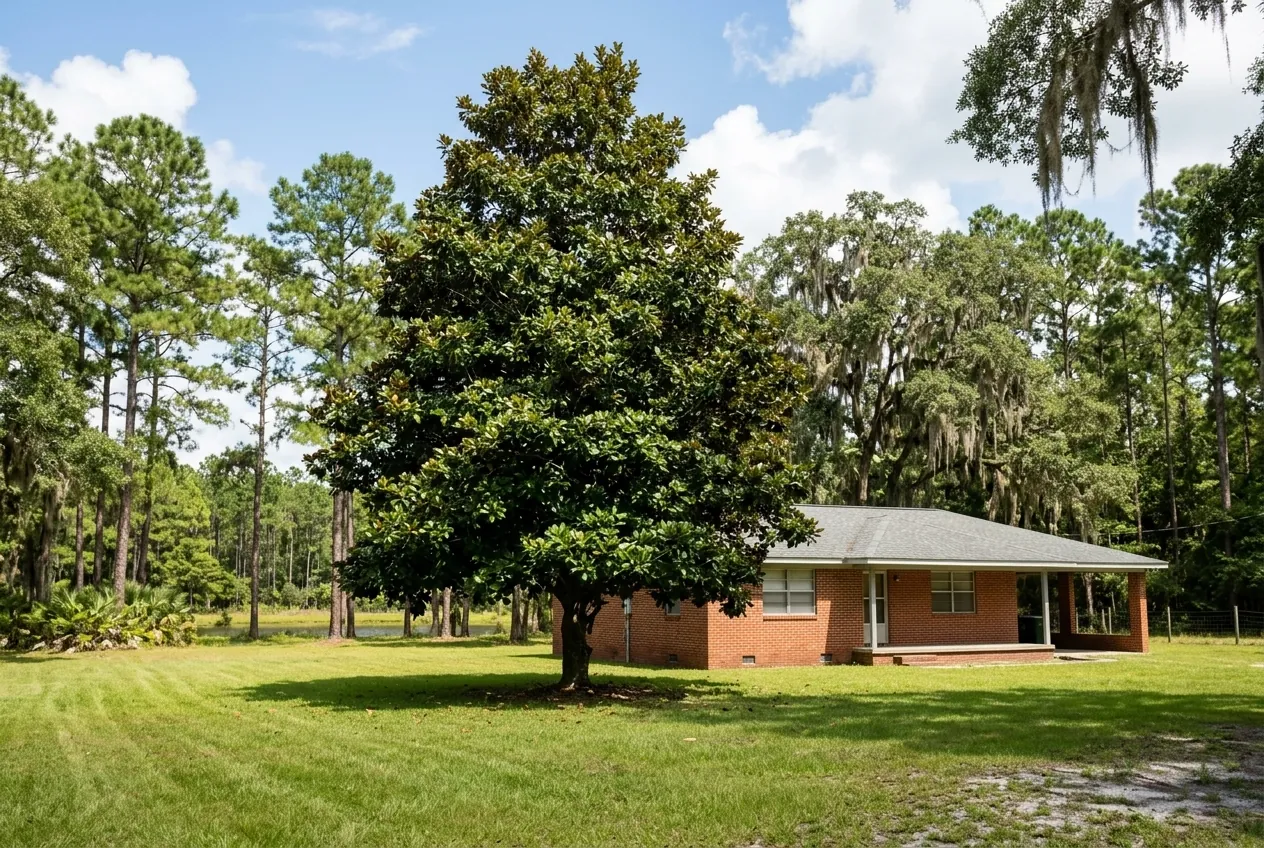
- Sweetbay magnolia. A narrower, smaller cousin of southern magnolia that handles damp spots well.
Where to Plant Shade Trees on a Lake City Lot
Plenty of tree removals trace back to a tree planted too close to something. A few spacing rules of thumb:
- Power lines. Lake City's tree ordinance calls for large trees at least 30 feet from the nearest overhead conductor and medium trees at least 20 feet away. Small trees can go closer only where the line is more than 20 feet above the ground.
- Buried utilities. The same code asks for at least five feet from buried lines. Call 811 before you dig.
- House and roof. Large oaks belong at least 20 to 30 feet from the foundation. Smaller trees like Florida maple can go closer.
- Septic drain fields. Keep big, thirsty trees well away to avoid root intrusion.
- West and south sides. Trees on these sides shade the house during the hottest part of the day, which is where they cut cooling bills the most.
Planting and Caring for Shade Trees in Columbia County
In north Florida, the cool months from late fall through winter are a good time to plant trees, since lower temperatures and fewer storms give roots time to grow before summer heat. Plant with the top of the root flare at or slightly above soil level, never buried. UF/IFAS establishment guidance calls for frequent watering for months after planting, with larger trees needing a longer establishment period. Mulch a wide ring around the trunk but keep mulch off the bark itself.
For specific questions about soil, species or pests, UF/IFAS Extension Columbia County in Lake City offers horticulture help to residents, including advice on Florida-Friendly plants.
Replacing Trees You Lost in Recent Storms
Many Lake City homeowners lost a tree or two to Helene, Idalia or beetles afterward. If you want a new tree where the old one stood, grind out the old stump first so the new tree is not fighting old roots and decay. Our stump grinding service handles that, and our tree removal crew can take down a damaged tree that is not worth saving. Grinding usually leaves enough room to plant a new tree a few feet from the old spot.
We work with homeowners in Lake City and across Columbia County, from Watertown to Five Points, and into nearby towns like Live Oak. If you are planning a new planting near existing trees and want an opinion on which ones to keep, request a free estimate or learn more about our tree service in Lake City.